
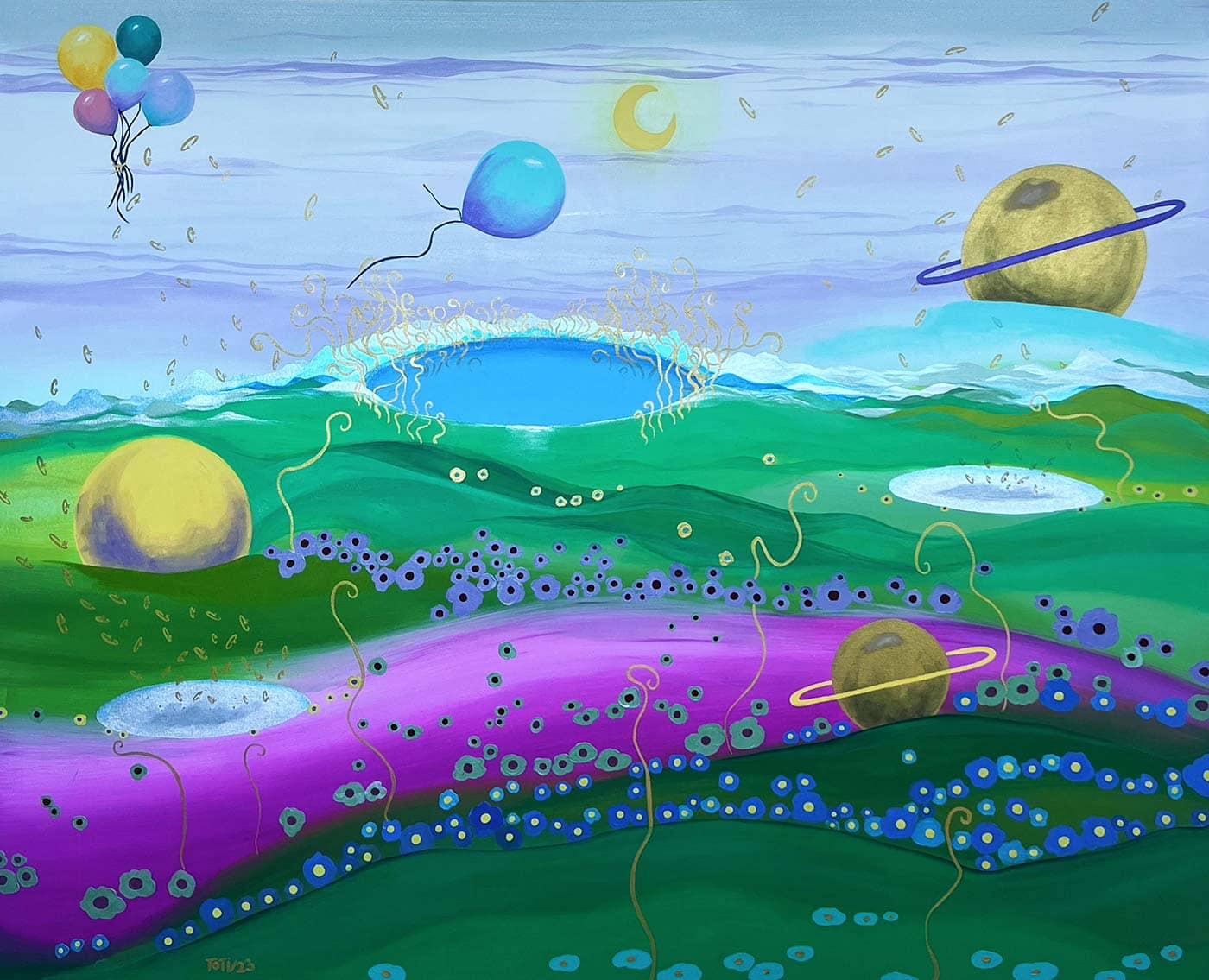
The Garden Of Delights II: The Playground is a 2023 large-scale acrylic painting by Rosana Auqué that reimagines paradise as a luminous space of play, wonder, and fearless emotional lightness.
The Garden Of Delights II: The Playground
Year: 2023
Medium: Acrylic on canvas
Dimensions: 2.1 x 1.7 mt
Private collection in Italy
The Garden Of Delights II: The Playground (2023)
The Garden Of Delights II: The Playground is a large-scale contemporary painting created in 2023 by Rosana Auqué. This work expands the conceptual universe of her “Garden” series into a territory of radical joy — a space intentionally freed from fear, guilt, and existential weight.
Inspired by one of the most fascinating paintings in the history of art — The Garden of Earthly Delights by Hieronymus Bosch — Auqué reinterprets the idea of paradise through a contemporary lens. Instead of moral tension or allegorical warning, she proposes a playground: a symbolic environment where life is light, sweet, and unapologetically alive.
This painting does not illustrate innocence. It defends it.
Inspired by Bosch, Reimagined as Joy
From Moral Allegory to Emotional Freedom
Hieronymus Bosch’s masterpiece is often interpreted as a meditation on temptation, chaos, and the fragile condition of humanity. Rosana Auqué approaches that historical reference not to replicate its narrative, but to transform its emotional charge.
In The Garden Of Delights II: The Playground, the traditional triptych of tension becomes a singular open field — a visual playground where no punishment follows pleasure, and no shadow overshadows wonder. The composition feels expansive and breathable. Figures and elements coexist in harmony, suspended in a luminous atmosphere that suggests emotional permission rather than judgment.
This is not an escape from reality.
It is a conscious decision to experience it differently.
A Space Without Fear
Painting as Emotional Architecture
The Playground is imagined as a psychological territory. A place where sadness, anxiety, and self-doubt are intentionally excluded. Not denied — but left outside the frame.
The large dimensions (2.1 meters by 1.7 meters) allow the viewer to physically enter the work. Scale matters here. The painting does not sit quietly on the wall; it envelops.
Color plays a structural role. Vibrant tonal contrasts and dynamic movement guide the eye upward and outward. There is a sensation of levitation, of suspension — as if gravity itself were softened. The recurring presence of balloons, playful forms, and organic elements reinforces the idea of lightness, but beneath that surface lies a more radical message:
Life is temporary.
Being alive is enough.
Joy is not naïve — it is an act of courage.
The Contemporary Meaning of Paradise
Choosing Lightness in a Complex World
In a time defined by overstimulation and constant seriousness, The Garden Of Delights II: The Playground proposes a counter-position. It invites the viewer to stop taking themselves so seriously.
This is not decorative optimism. It is philosophical softness.
The painting suggests that adulthood does not require the abandonment of wonder. That responsibility can coexist with play. That existence, in its fragility, deserves celebration.
Rather than presenting paradise as a distant promise, Auqué frames it as a state of perception. A shift. A decision.
The playground is not a location.
It is a mindset.
Technical Details and Artwork Information
Artwork Specifications
Title: The Garden Of Delights II: The Playground
Artist: Rosana Auqué
Year: 2023
Medium: Acrylic on canvas
Dimensions: 2.1 meters x 1.7 meters
This painting is part of Rosana Auqué’s ongoing exploration of emotional elevation, symbolic lightness, and contemporary reinterpretations of classical references.
Frequently Asked Questions
What is the main concept behind The Garden Of Delights II: The Playground?
The painting reimagines Bosch’s historical “garden” as a contemporary playground — a space dedicated exclusively to joy, emotional freedom, and the conscious decision to experience life lightly.
Is this artwork directly inspired by Hieronymus Bosch?
Yes. It is conceptually inspired by Bosch’s The Garden of Earthly Delights, but instead of focusing on moral tension or chaos, it transforms the idea into a space of happiness and psychological liberation.
What makes this work significant within Rosana Auqué’s practice?
It deepens her ongoing exploration of levitation, symbolic elevation, and the idea of emotional ascension. It also reflects her interest in reinterpreting historical art references through a contemporary, optimistic perspective.